
Packaging Compliance Guide
Quick Answer: The EU Packaging and Packaging Waste Regulation (PPWR) affects how beauty brands evaluate packaging materials, supplier documentation, recyclability planning and packaging-related responsibilities before products enter the EU market. For skincare and cosmetics buyers, the practical priority is not simply choosing a “sustainable-looking” pack—it is building a packaging file that can support your product, market route and supply-chain responsibilities.
Cosmetic packaging is no longer only a branding, cost or shelf-impact decision. For brands selling into the European Union, packaging choices increasingly affect documentation, supplier coordination, import planning and long-term product continuity.
At INTE Cosmetics, we support beauty brands with private label, OEM and ODM manufacturing, including the practical coordination required between formula, filling process, packaging components and product-market requirements. This guide explains what procurement teams should understand about PPWR compliance for cosmetic packaging—and what to confirm with a manufacturing and packaging partner before production begins.
The EU Packaging and Packaging Waste Regulation, commonly called PPWR, creates a harmonised packaging framework across the EU. It covers packaging placed on the EU market and introduces requirements that address areas such as packaging minimisation, recyclability, material information, labelling and conformity documentation. Its requirements apply on a phased basis, so brands should assess their packaging roadmap early rather than waiting until a launch is close.
For beauty brands, PPWR is relevant to common formats including cosmetic jars, bottles, pumps, droppers, tubes, pouches, cartons, applicators and secondary packaging. A product may look simple on shelf, but its final packaging system can involve multiple materials, components and suppliers. That is why buyers should treat packaging compliance as a supply-chain workstream—not a last-minute artwork task.
Important: PPWR responsibilities depend on the packaging type, the applicable requirement, the legal role of each economic operator and the route by which goods are placed on the EU market. This article is a practical procurement guide, not legal advice. Your brand, EU Responsible Person, importer and regulatory adviser should confirm the obligations that apply to your specific products.
The most common risk is not that a buyer deliberately selects non-compliant packaging. The risk is that packaging decisions are made without a clear record of materials, component specifications, supplier documents, change-control procedures or role allocation.
For example, a premium glass serum bottle may include a glass bottle, an aluminium collar, an elastomer bulb, a plastic pipette, a printed label and a folding carton. A skincare jar may include an outer cap, inner lid, seal, spatula and carton. Each component should be traceable within the final packaging specification.
This is particularly important for brands sourcing private label cosmetic packaging alongside formulation and filling. Packaging development should be reviewed with the product format, formula compatibility, target market and production process in mind—not selected in isolation.
For EU-Bound Beauty Projects
Share your product type, target market and preliminary packaging concept with our team. We can help you identify the component information, supplier documents and production considerations to review before your project moves forward.
Request a Packaging Compliance Pre-Check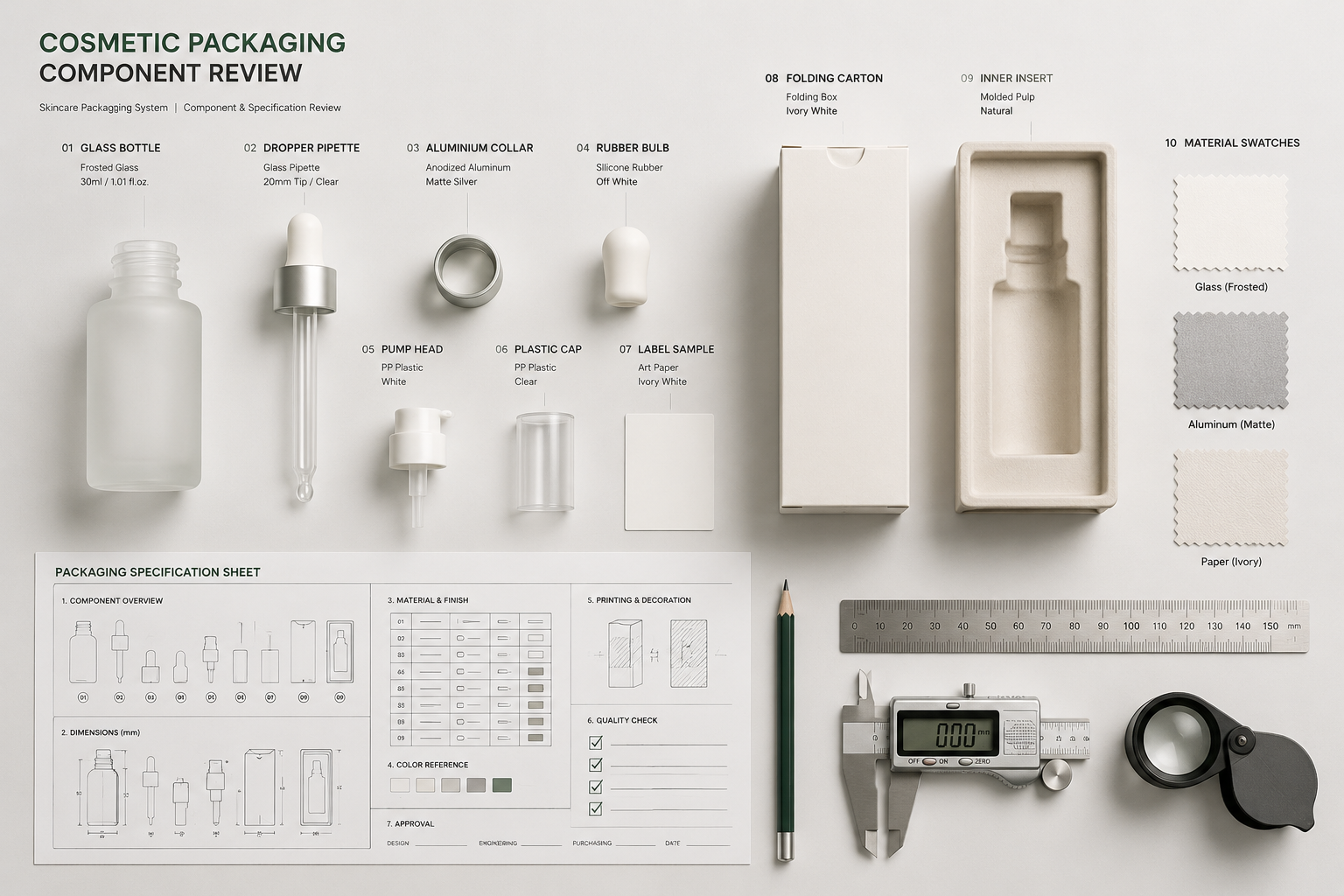
Buyers should not wait until goods are ready to ship before asking what packaging records are available. Before approving packaging for an EU-bound beauty product, request a clear document plan from your manufacturer and relevant packaging suppliers.
| Document / Information | Why It Matters | What Buyers Should Confirm |
|---|---|---|
| Packaging specification sheet | Defines the packaging system and its components. | Material, dimensions, component structure, finish and approved version. |
| Material information | Supports assessment of the materials used in each component. | Whether information covers the primary pack, closures, labels and relevant secondary packaging. |
| Compatibility and filling review | Helps reduce leakage, deformation, separation, pump failure or formula-pack interaction risks. | Whether the formula, fill process and selected pack have been assessed together. |
| Test records, where applicable | May support the technical file and product quality evaluation. | Scope of test, sample type, test conditions and whether the result applies to the final pack. |
| Supplier change-control process | Helps protect repeat orders from unapproved material or component changes. | How changes are notified, reviewed and approved before production. |
| Traceability information | Supports batch-level investigation if a packaging issue occurs. | How packaging lots, finished-product lots and supplier records are connected. |
The required documentation will vary by packaging type, market route and legal role. However, a manufacturer that can clearly explain its documentation process, packaging-supplier coordination and approval workflow gives procurement teams a stronger foundation than one that only provides a visual render or a unit price.
PPWR includes requirements concerning conformity assessment, technical documentation and an EU Declaration of Conformity for packaging where applicable. The party legally defined as the packaging manufacturer under the regulation carries the responsibility for demonstrating compliance. This legal role may not always be the same as the cosmetics factory, the brand owner, the packaging component supplier or the importer.
For this reason, buyers should avoid asking a cosmetic manufacturer to “guarantee all PPWR compliance” without clarifying the packaging supply structure and market roles. A more practical question is:
“For this packaging configuration, which documents can each supplier provide, who consolidates them, and which party holds the final legal responsibility in our EU supply chain?”
At INTE, we can coordinate relevant factory-side product information, packaging specifications and supplier-provided documents within the agreed project scope. We also work with buyers to make sure formula, filling, package selection and artwork discussions are aligned before mass production. Where legal interpretation is required, brands should work with their EU Responsible Person, importer or qualified regulatory adviser.

A common sourcing error is to treat the European Union and the United Kingdom as one packaging-compliance market. They are not. PPWR is an EU regulation, while Great Britain operates its own packaging Extended Producer Responsibility (EPR) framework. Your obligations can differ depending on whether products are being sold in the EU, Great Britain or Northern Ireland.
If your skincare or cosmetics project is intended for both EU and UK distribution, your packaging plan should identify the target jurisdictions early. You can also review our EU & UK Skincare OEM Import & Sales Solution for a broader overview of market-entry preparation.
As a cosmetics manufacturer, our role is to help turn your product brief into a manufacturable packaging-and-formula system. Compliance preparation is strongest when it begins during development—not after your purchase order has been placed.
PPWR preparation should also be considered alongside wider cosmetic compliance. For a broader overview of manufacturing documentation, MoCRA support and EU cosmetic-notification preparation, read our guide to cosmetic manufacturing compliance for MoCRA and CPNP.

Use the following checklist when evaluating cosmetic packaging for an EU-bound project:
PPWR covers packaging placed on the EU market, which can include packaging used for skincare, cosmetics and personal-care products. The exact requirements and timing depend on the packaging type, the applicable provisions and the roles within your supply chain.
Not necessarily. Packaging compliance responsibilities depend on the legal role of the brand, packaging manufacturer, component supplier, importer and other economic operators. We can support with factory-side coordination, product specifications and supplier-document collection within the agreed scope, while the responsible legal party must confirm final obligations.
Start during product development—before final packaging approval and mass-production planning. Early review gives your team more flexibility to adjust components, material choices, specifications and documentation responsibilities without disrupting launch timing.
Start with a Clear Packaging Plan
Tell us about your product category, target market, formula concept and preferred packaging format. Our team can help you review practical manufacturing and packaging considerations before you move into sampling or mass production.
Request Compliance Documentation GuidanceRegulatory note: This article provides general business and procurement information only and does not constitute legal advice. PPWR requirements, implementation measures and market-specific obligations may change. Consult your EU Responsible Person, importer, legal counsel or regulatory adviser for product-specific guidance.
Reference sources: Regulation (EU) 2025/40 | European Commission PPWR Overview | UK Packaging EPR Guidance
 Hot News
2026-11-23
2026-11-24
2026-11-23
2026-11-20
2026-11-19
2026-11-17
Copyright © 2025 by Inte Cosmetics (shenzhen) Co., Ltd.
 EN