 EN

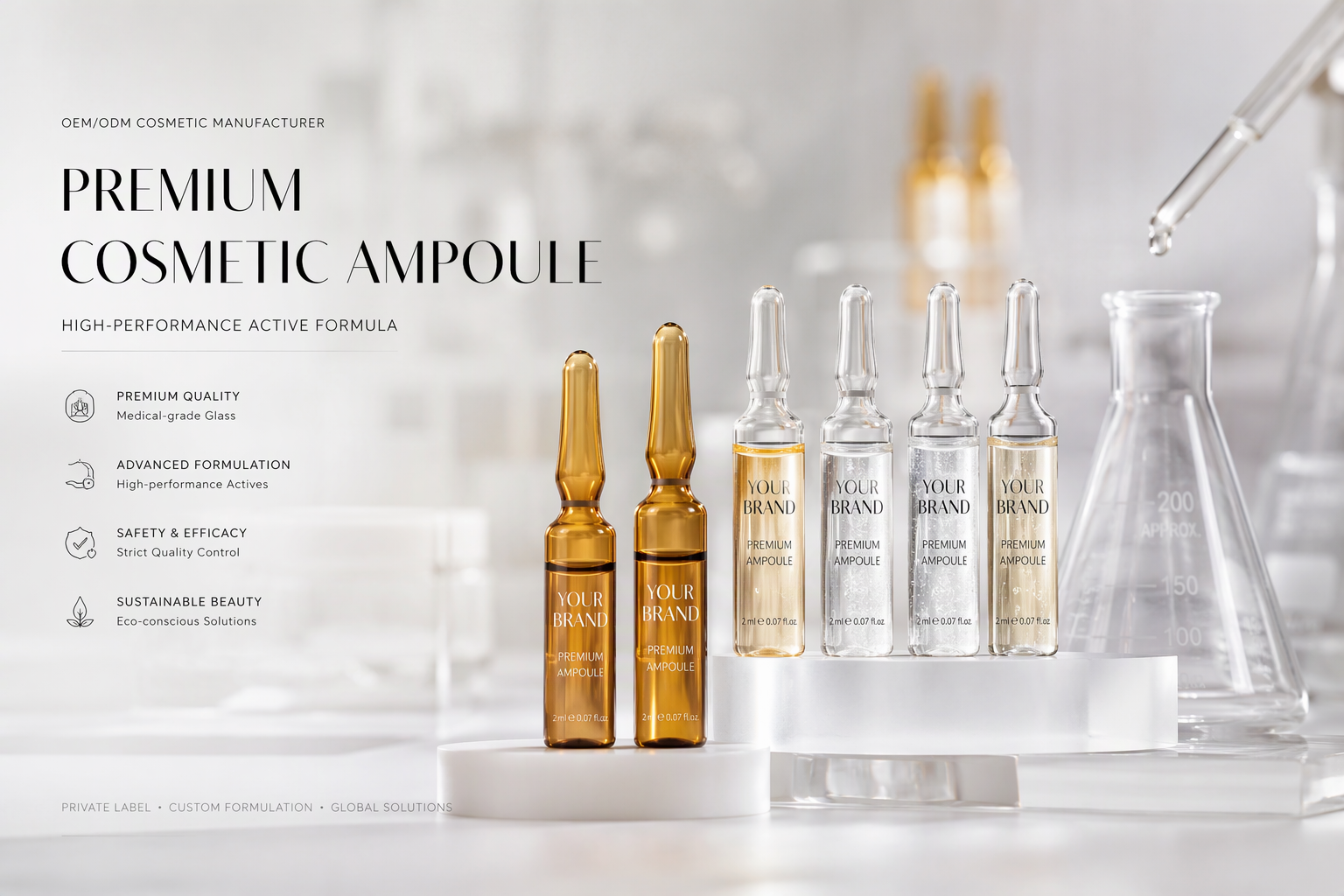
Ampoule serum storage and stability depend directly on three interconnected pillars: active ingredient formulation sensitivity, primary packaging barrier integrity (such as nitrogen-flushed amber glass or sterile BFS polymers), and supply chain temperature control (maintaining 15–25°C / 59–77°F with <60% RH). For B2B private label brands and distributors, preventing thermal shock, photolysis, and oxygen ingress during international ocean freight and warehouse storage is essential to preserving active ingredient potency (such as L-Ascorbic Acid, Retinol, and Peptides) across a standard 24–36 month shelf life.
Ampoule serums represent the peak of intensive active skincare—delivering ultra-high concentrations of unstable actives such as pure Vitamin C, bio-ferments, growth factors, PDRN, and oligopeptides. Because these formulas often eliminate or strictly minimize conventional preservative systems, their stability profile is significantly more fragile than standard bottled serums.
For beauty brand founders, procurement managers, and cross-border importers, proper ampoule serum storage is not merely post-purchase consumer advice; it is a critical commercial specification. Improper storage during trans-oceanic shipping, custom clearance holding, and warehouse fulfillment can cause active degradation, phase separation, pH drift, and customer complaints before the product ever reaches retail shelves.
In This Guide
- 1. Environmental Degradation Mechanisms: Light, Heat, and Oxidation
- 2. Recommended Storage Conditions for Warehousing & Distribution
- 3. Primary Packaging Selection: Glass Ampoules vs. BFS vs. Nitrogen Purging
- 4. Cold Chain & Temperature-Controlled Logistics Protocols
- 5. Stability Testing & Shelf-Life Verification (ICH Standards)
- 6. Secondary Packaging Design & Consumer Usage Labeling
- 7. How INTE Supports Private Label Ampoule Development & QC
- 8. Frequently Asked Questions (FAQ)
1. Environmental Degradation Mechanisms: Light, Heat, and Oxidation
In high-potency ampoule serums, unstable active ingredients degrade through specific chemical pathways when exposed to environmental stresses. Understanding these failure modes allows formulation engineers and procurement teams to design effective packaging and storage safeguards early in the product lifecycle.
| Environmental Factor | Degradation Kinetic | Target Actives Impacted | Physical & Chemical Manifestation |
|---|---|---|---|
| UV & Visible Light | Photodegradation & photo-oxidation (~4.1x acceleration) | Retinoids, Vitamin C, Niacinamide, Botanical extracts | Color shift (yellowing/browning), active titer loss, odor change |
| Thermal Stress (>25°C / 77°F) | Arrhenius reaction acceleration (~3.7x per +10°C) | Peptides, Growth Factors, Probiotics, Enzymes | Peptide bond cleavage, emulsion thinning, active denaturation |
| Oxygen Ingress | Free radical oxidation chain reactions (~5.2x rate) | L-Ascorbic Acid, Resveratrol, Ferulic Acid, Lipids | Severe browning, lipid peroxide accumulation, loss of antioxidant ORAC value |
| Humidity & Moisture (>60% RH) | Hygroscopic absorption & microbial pressure | Lyophilized powders, unsealed ampoule caps | Cake collapse, particulate formation, preservative system stress |
Formulation stability research indicates that unsealed or poorly barrier-protected ampoules can lose up to 60% of active potency within 30 days when exposed to ambient temperature swings and elevated humidity. For B2B buyers, specifying high-barrier containment is the first line of defense.
2. Recommended Storage Conditions for Warehousing & Distribution
To ensure stability across the entire commercial supply chain, brand owners and logistics partners should implement standardized ambient storage criteria:
- Controlled Room Temperature (CRT): Maintain warehouse facilities strictly between 15°C and 25°C (59°F–77°F). Short-term excursions up to 30°C during handling must not exceed 24 hours.
- Relative Humidity (RH) Limits: Keep storage zones below 60% RH to prevent outer carton moisture softening and seal fatigue.
- Dark Storage (UV Elimination): Store master cartons and inner boxes away from direct skylights or unfiltered high-intensity warehouse halogen lighting.
- Pallet Clearance: Keep palletized goods at least 15 cm off floor level and away from external facility walls to prevent localized condensation.
- FIFO Inventory Management: Enforce strict First-In, First-Out (FIFO) batch tracking to prevent aging inventory accumulation.
3. Primary Packaging Selection: Glass Ampoules vs. BFS vs. Nitrogen Purging
Packaging is the primary barrier that protects sensitive actives from ambient degradation. When developing a custom ampoule line, buyers should evaluate packaging formats against formula chemistry, target unit cost, and transportation durability.
| Packaging Format | Gas/Oxygen Barrier | Light Protection | Transportation Durability | Ideal Formulation Types |
|---|---|---|---|---|
| Amber Glass Flame-Sealed Ampoule | Absolute Hermetic Seal (Zero O2 transmission) | Superior (>99% UV blockage) | Requires molded blister trays to avoid breakage | Pure L-Ascorbic Acid, Retinol, Preservative-Free Actives |
| Blow-Fill-Seal (BFS) Polyolefin / PP | High (Sterile unit-dose aseptic forming) | Moderate to High (tinted/opaque grades) | Shatterproof & Lightweight (Low freight cost) | Hyaluronic Acid, Ectoin, Soothing/Barrier Repair Essences |
| Multi-Dose Dropper Bottle with Nitrogen Purge | Moderate (Exposed upon consumer opening) | High (Amber/Coated glass) | High | Stabilized active complexes, daily maintenance serums |
| Dual-Chamber / Freeze-Dried Lyophilized Unit | Superior (Moisture & O2 vacuum sealed) | High | High (Protected in outer casing) | Oligopeptides, PDRN, Freshly activated enzyme solutions |
For complete packaging specifications, MOQ tiers, and custom mold options, explore our Private Label Cosmetic Packaging solutions.
Planning a Private Label Ampoule Serum Line?
From high-potency antioxidant formulation to flame-sealed glass ampoules and shatterproof BFS single-dose formats, INTE provides end-to-end OEM/ODM manufacturing with rigorous stability validation.
Discuss Your Ampoule Formulation Brief4. Cold Chain & Temperature-Controlled Logistics Protocols
One of the biggest risks for cosmetic importers is heat exposure during intercontinental shipping. Inside standard shipping containers exposed to direct sunlight at sea or in port yards, ambient temperatures can exceed 55°C (131°F).
When refrigerated storage (2–8°C / 35–46°F) is required for raw bulk or finished goods, ensure items are packaged with moisture-impermeable overwraps to prevent condensation from forming on ampoule neck seals during temperature equilibration.
5. Stability Testing & Shelf-Life Verification (ICH Standards)
Before commercial batch manufacturing, every custom ampoule formulation must undergo standardized stability validation to verify real-world shelf life. At INTE, our R&D laboratory adheres to international cosmetic testing protocols:
- Accelerated Stability Testing (ICH Q1A): 3 Months at 40°C ± 2°C / 75% RH ± 5% RH (conventionally equivalent to ~24 months of real-time ambient shelf life).
- Real-Time Long-Term Testing: 12–36 Months at 25°C ± 2°C / 60% RH ± 5% RH.
- Freeze-Thaw Cycling: 3 to 5 alternating cycles between -10°C and +40°C to verify emulsion stability, clarity, and seal elasticity.
- Photostability Testing (ICH Q1B): Exposure to UV and visible light to confirm packaging opacity and active retention.
- Microbial Challenge Testing (USP 51 / ISO 11930): Ensuring single-use sterile and low-preservative formulations remain biologically uncompromised.
For brands selling into the US or European Union, review our MoCRA & CPNP Cosmetic Manufacturing Compliance Guide to understand required Safety Assessments (CPSR) and stability documentation.
6. Secondary Packaging Design & Consumer Usage Labeling
Even the best-manufactured ampoule can suffer from consumer misuse if instructions and secondary packaging are inadequate. For B2B brands, we advise incorporating these design elements:
- Individual Blister Cavities: Protect fragile glass necks during drop testing and shipping impacts.
- Single-Dose Volume Sizing: Standardize fills to 1.0 ml – 1.5 ml to ensure complete single-session use and eliminate the need for partial-dose storage.
- Clear Opening & Storage Icons: Include explicit visual diagrams on carton sleeves detailing ampoule neck breaking, silicone sleeve attachment, and "Single-use immediate application" directives.
- UV-Barrier Cartons: Utilize dense, UV-varnished paperboard folding boxes to provide secondary light shielding.
7. How INTE Supports Private Label Ampoule Development & QC
At INTE Cosmetics, we partner with skincare brands, aesthetic clinics, and global distributors to deliver stable, high-performance ampoule products:
- Automated Cleanroom Filling: ISO 22716 & GMPC certified cleanrooms with precision volumetric micro-dosing.
- Nitrogen Purging Technology: In-line nitrogen flushing to remove dissolved oxygen prior to hermetic flame sealing.
- Diverse Packaging Platforms: Medical-grade amber glass ampoules, BFS sterile unit-dose plastic ampoules, and dual-chamber freeze-dried vials.
- Custom Formulation & Active Delivery: Specialized micro-emulsions, liposomal encapsulation, and high-concentration antioxidant systems.
- Comprehensive Compliance Support: Complete testing data, COA, MSDS, and formulation dossiers ready for global market registration.
Explore our broader face care capabilities across our Face Care Manufacturing Range.
Ready to Develop a Differentiated Ampoule Skincare Line?
Share your target active ingredients, preferred unit-dose packaging format, and launch timeline. Our formulation engineers and packaging specialists will build a tailored OEM/ODM proposal.
Request an Ampoule Consultation & Samples8. Frequently Asked Questions (FAQ)
Table of Contents
- 1. Environmental Degradation Mechanisms: Light, Heat, and Oxidation
- 2. Recommended Storage Conditions for Warehousing & Distribution
- 3. Primary Packaging Selection: Glass Ampoules vs. BFS vs. Nitrogen Purging
- 4. Cold Chain & Temperature-Controlled Logistics Protocols
- 5. Stability Testing & Shelf-Life Verification (ICH Standards)
- 6. Secondary Packaging Design & Consumer Usage Labeling
- 7. How INTE Supports Private Label Ampoule Development & QC
- 8. Frequently Asked Questions (FAQ)
